Know Sure Thing
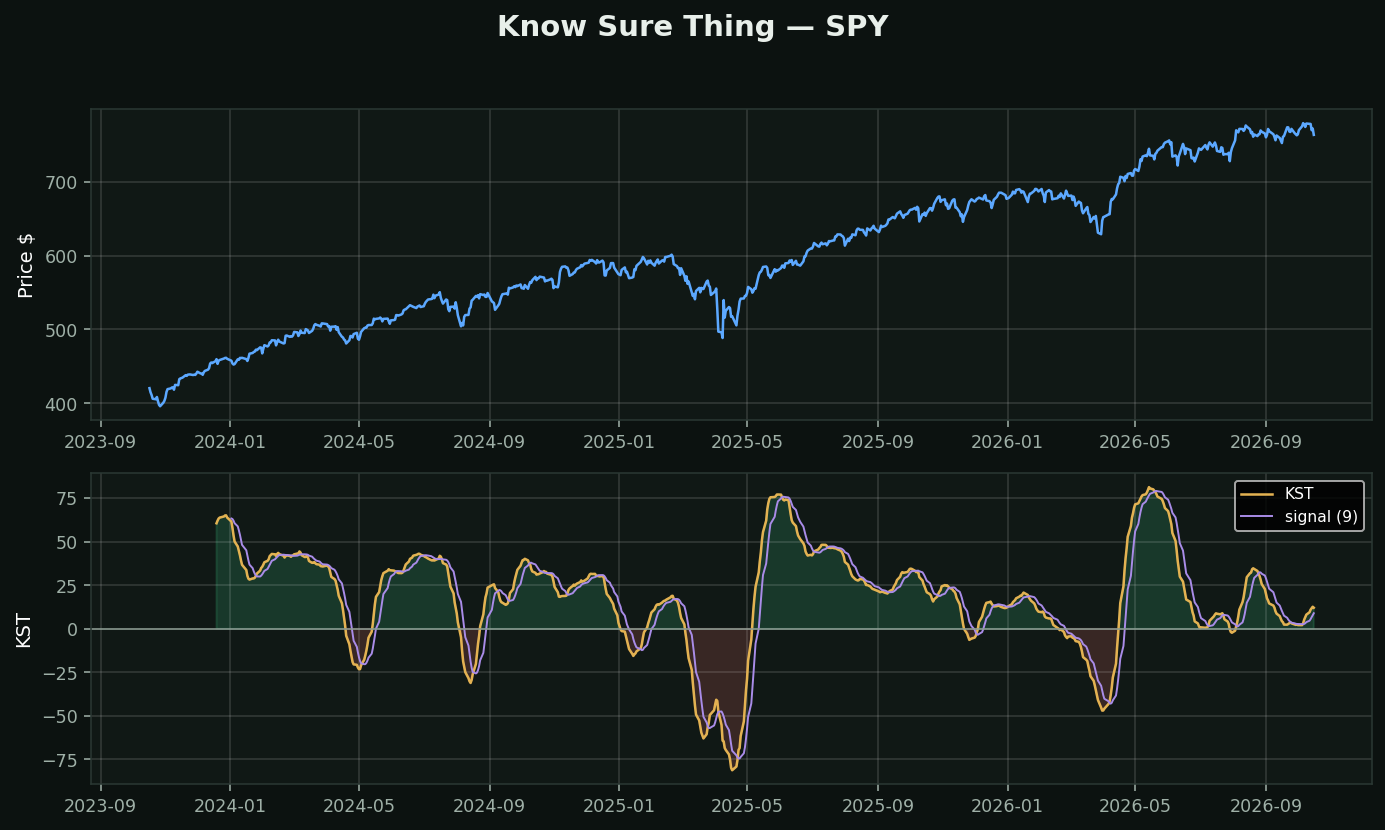
What it is: four rate-of-change readings — 10, 15, 20 and 30 periods — each smoothed, then added up with weights of 1, 2, 3 and 4. Martin Pring. The name is a joke about how certain nothing in this field is.
The idea behind it: markets contain several cycles running at once. Any single-lookback momentum reading is tuned to one of them and blind to the rest. KST sums four and deliberately weights the LONGEST heaviest — the opposite of the Ultimate Oscillator's choice, which weights the shortest heaviest. Same problem, two defensible answers.
What that weighting means in practice: KST is slow on purpose. It is built for weekly and monthly charts and for asking "what is the primary trend", not "what do I do Tuesday".
How traders use it:
• Zero-line crossings as a long-cycle regime marker
• Signal-line crossings for the faster read
• The weights (1/2/3/4) and periods are arbitrary — Pring picked them by inspection. Anyone quoting them as optimal is guessing
What testing here found: this is a trend-following tool, and that family did not survive its own test. Over 413,946 stock-days, "price above its moving averages" preceded -0.46% at 21 days (t=-4.40) while downtrend preceded +1.14% (t=+6.02). Use it to describe a trend and to manage a stop — not to decide direction.